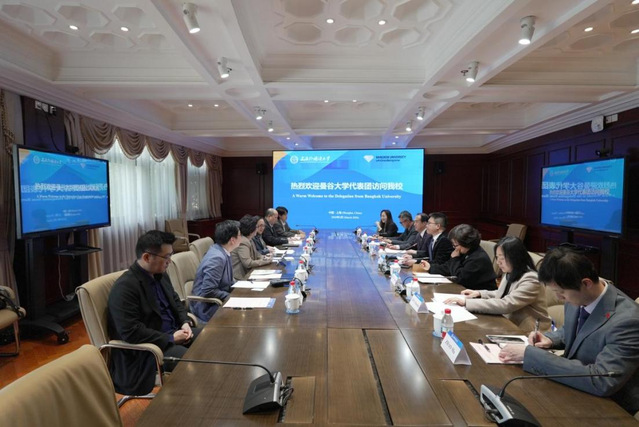
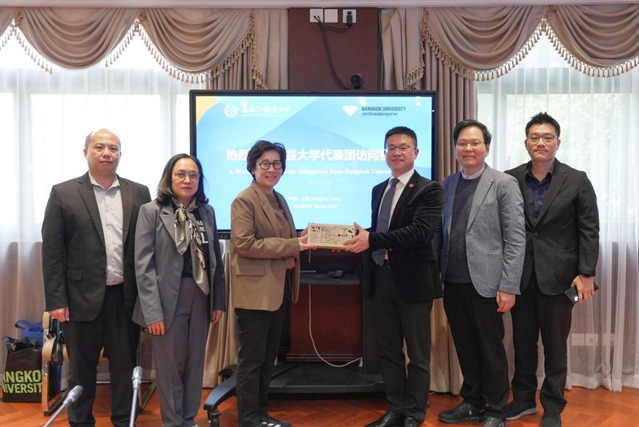
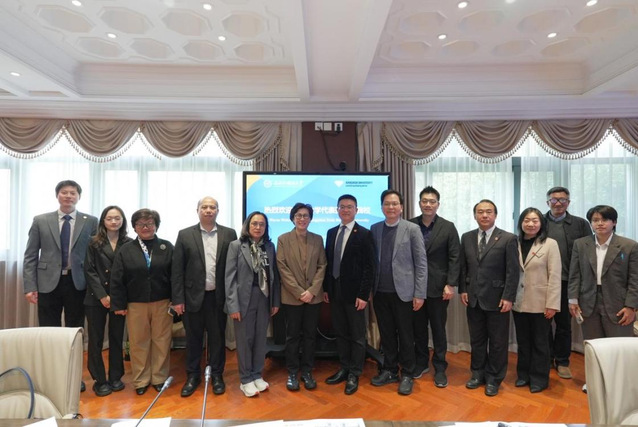
On March 25, a delegation from Bangkok University, led by Aunya Singsangob, Vice President for Academic Affairs, visited Shanghai International Studies University (SISU). Yi Yonggang, Vice President of SISU, met with the delegation at the Hongkou Campus. Heads of relevant units, including the Graduate Institute of Interpretation and Translation, the School of Asian and African Studies, the School of Chinese Studies and Exchange, the School of Journalism and Communication, and the Office of International Cooperation and Exchange, attended the meeting. The two sides exchanged views on restarting and deepening inter-university cooperation, expanding disciplinary exchanges, and innovating talent cultivation models.
Yi extended a warm welcome to the delegation on behalf of the university and introduced SISU’s history, disciplinary strengths, and directions for future transformation. He noted that, since its founding nearly 80 years ago, Shanghai International Studies University has built its foundation on language research and teaching, developing distinctive strengths in the humanities and social sciences. The university is currently advancing two major strategic transformations: integrating area studies with language education, and promoting deep interdisciplinary collaboration between language disciplines and science and engineering. He also pointed out that SISU and Bangkok University established a solid foundation for cooperation more than a decade ago, and expressed the hope that this visit would serve as an opportunity to further develop practical collaboration in areas such as faculty and student exchanges, joint training programs, and disciplinary collaboration.
Aunya Singsangob expressed her gratitude for the warm reception and introduced Bangkok University’s strengths and experience in international cooperation in fields such as translation studies, communication studies, and law. She spoke highly of the alignment between the two universities in terms of disciplinary structure and internationalization strategies, and expressed her hope that both sides could work together to explore diverse cooperation models in areas including language education, translation talent development, and digital media. These may include “2+2” and “3+1” joint training programs, short-term exchanges for faculty and students, as well as academic and research collaboration, with the aim of cultivating interdisciplinary talents.
During the meeting, representatives from SISU held focused discussions with the delegation, identifying concrete areas for collaboration based on their respective strengths. Proposed initiatives included the development of certificate programs in translation and interpreting, the joint establishment of a master’s program in Thai–Chinese–English translation, expanded cooperation in digital media, and sharing resources to support Chinese language education. The Office of International Cooperation and Exchange stated that it would work to reactivate and upgrade the cooperation agreement between the two universities and further refine plans for joint training and dual-degree programs.
This meeting served as a productive platform for dialogue between the two universities. Both sides noted that they will begin with faculty and student exchanges and joint training programs, with plans to further develop collaboration in areas such as disciplinary program development and research. Through these efforts, they aim to take China–Thailand higher education cooperation to the next level and cultivate highly qualified talents to promote cultural exchange and economic ties between the two countries.